


Rats vs Mice Brisbane: 7 Warning Signs to Tell Which Rodent You Have
Rats vs mice Brisbane homeowners keep asking: scratching in the ceiling, chewed packaging in the pantry, droppings along the skirting board — you know you've got a rodent problem, but which one is it? It's not just a curiosity. Rats and mice nest differently, feed differently, and need different bait placement and control strategies, so treating one like the other often means the problem drags on. Here's how to tell them apart, and what to do next.
In This Article
Why Rodents Are So Common in Brisbane Homes
Brisbane's mix of established suburbs, overhanging trees, and homes backing onto bushland or green corridors gives rats and mice easy access points and plenty of shelter. Roof voids, subfloor spaces under older Queenslanders in suburbs like Moorooka, and gaps around eaves are all common entry routes.
Activity tends to pick up in the cooler months as rodents move indoors seeking warmth and steady food sources, but in Brisbane's mild climate, infestations can establish and grow at almost any time of year if conditions are right. This is especially true across larger properties and semi-rural corridors in Ipswich and Logan.
Good to know: A single pair of mice can produce dozens of offspring within a few months. What looks like a small problem in autumn can be a full infestation by the time winter ends.
Rats vs Mice Brisbane: How to Tell Them Apart
Size is the most obvious clue, but droppings, gnaw marks, and behaviour are often more reliable indicators.
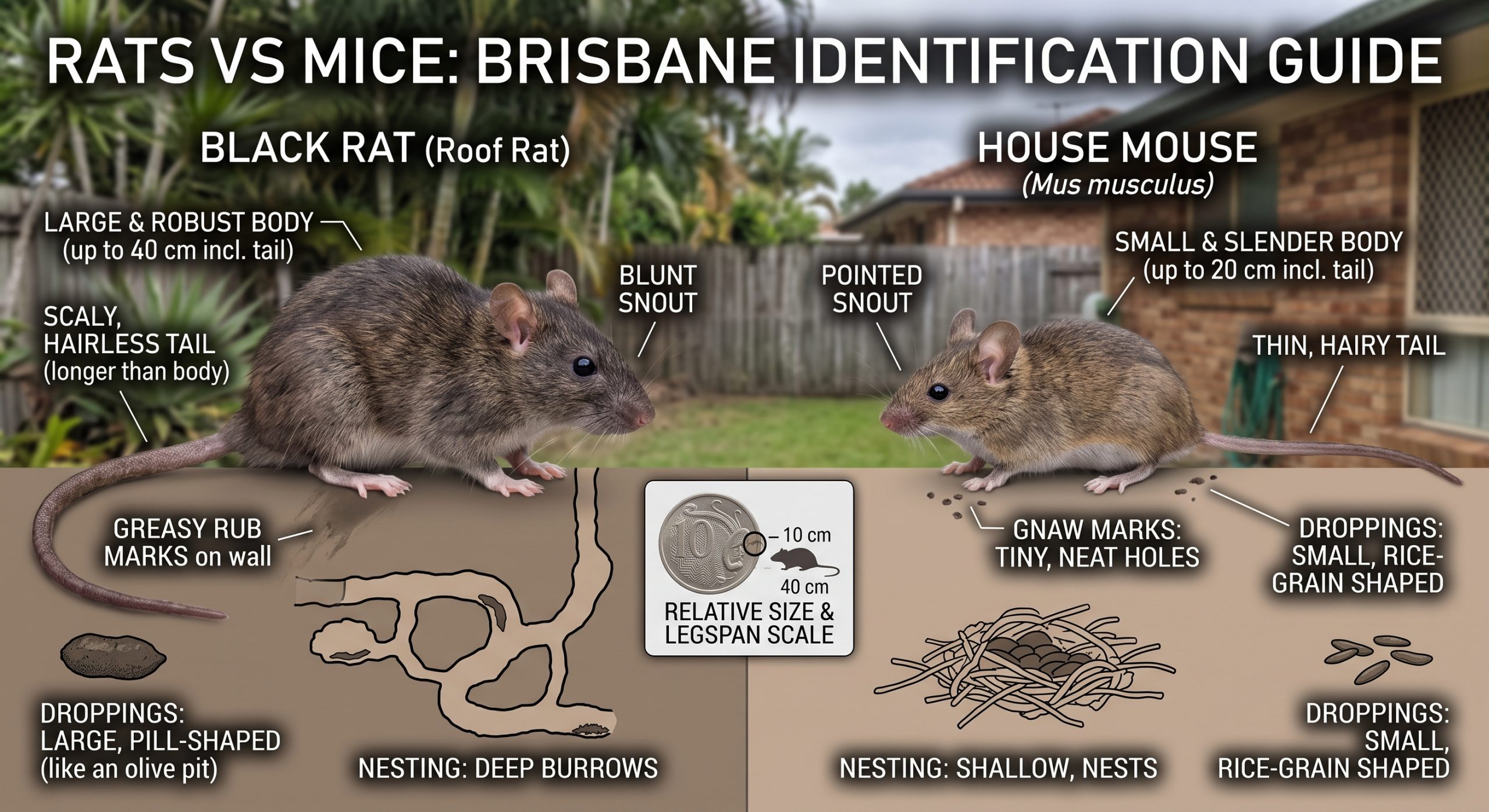
- Size: Mice are small, usually 7–10cm body length with large ears relative to their head. Rats are noticeably larger, often 20–25cm, with a thicker, more muscular build.
- Droppings: Mouse droppings are small (around rice-grain size) with pointed ends. Rat droppings are larger, more capsule-shaped, and often found in clusters near nesting or feeding sites.
- Gnaw marks: Rats leave larger, deeper gnaw marks and can chew through timber, plastic, and even soft metals. Mouse gnawing is finer and more scattered.
- Nesting behaviour: Mice tend to nest close to food sources — inside cupboards, wall cavities near kitchens. Rats often nest in roof voids, subfloors, or garden burrows and travel further to feed.
- Movement: Rats are more cautious and tend to stick to established routes along walls. Mice are more exploratory and will investigate new areas of a room.

Why the Difference Actually Matters for Treatment
Rats and mice don't respond to the same control methods in the same way. Bait stations sized and placed for mice are often ignored by rats, while rat-focused baiting may be overkill — or simply the wrong location — for a mouse problem confined to a kitchen.
- Rats typically need bait stations placed along their established outdoor and subfloor travel routes, plus entry point sealing at the roofline and foundation level.
- Mice usually need a higher density of smaller bait points placed closer to food sources and nesting areas indoors, since they range over a much smaller territory.
- Misidentifying the species is one of the most common reasons DIY rodent control fails — the bait is in the wrong place for the animal actually causing the problem.
⚠️ Important: Rodenticides bought over the counter can pose risks to pets and native wildlife if placed incorrectly. Professional bait stations are secured and positioned to target rodents only.
Not Sure If It's Rats or Mice?
Our licensed Brisbane technicians identify the species, locate nesting and entry points, and apply targeted treatment — not guesswork.
Book a Free InspectionWarning Signs You Have a Rodent Problem
- Scratching or scurrying noises in the ceiling or walls, especially at night
- Droppings along skirting boards, in cupboards, or near the pantry
- Gnawed food packaging, cardboard, or wiring
- A stale, musky odour in enclosed spaces like roof voids or under sinks
- Greasy rub marks along walls where rodents repeatedly travel the same route
- Pets acting unusually alert or focused on a particular wall, cupboard, or ceiling area in family homes across Aspley
"We could hear something in the ceiling every night but had no idea if it was rats or possums. Turned out to be rats nesting near the hot water system — once that was found, the treatment worked fast." — Brisbane homeowner, roof void rodent treatment
Health & Property Risks of Leaving It Untreated
Whichever side of the rats vs mice Brisbane question you land on, both pose real risks the longer an infestation goes unaddressed:
- Health risks: Droppings and urine can carry pathogens including salmonella, and contaminate food preparation areas even without direct contact.
- Fire risk: Rats and mice gnaw on electrical wiring, which is a genuine and often underestimated fire hazard in roof voids and wall cavities.
- Structural damage: Continuous gnawing on timber framing, insulation, and pipework can lead to costly repairs if left unchecked.
- Rapid breeding: Because both rats and mice breed quickly, a manageable problem can become a significant infestation within just a few months.
How to Rodent-Proof Your Home
- Trim overhanging branches back at least 1.5 metres from the roofline — they act as direct bridges onto your roof.
- Seal external gaps around pipes, vents, eaves, and foundations — rodents can squeeze through surprisingly small openings.
- Store food securely, including pantry staples and pet food, in sealed containers rather than original packaging.
- Clear garden debris and clutter that provides shelter close to the house.
- Keep bins sealed and away from direct wall access where possible.
- Schedule regular inspections, particularly heading into the cooler months when rodents are most likely to move indoors.
Frequently Asked Questions
Can I have both rats and mice at the same time?
Are DIY traps and baits effective?
How quickly will I notice results after treatment?
Is rodent control safe for pets?
Rodent Baiting & Eradication Across Greater Brisbane
Hearing scratching inside your ceiling cavities or subfloor? View our full Brisbane pest control service areas to confirm local emergency dispatch times and pet-safe rodent control programs in your area.
Solved the Rats vs Mice Brisbane Question? Let's Fix It
Get a proper inspection to identify the species, locate the nest, and stop the problem before it spreads — fast, safe, and backed by a satisfaction guarantee.